

Khuong My Cham Towers: The 1,000-Year-Old Mystery Near Hoi An
Most visitors to Hoi An hear about My Son Sanctuary, the region’s famous UNESCO-listed Cham ruins. Fewer know that a smaller, quieter, and completely free set of Cham towers stands just outside Tam Ky, and that archaeologists still can’t fully explain how it was built. If you’re curious about Champa history and want to see something most tourists skip, the Khuong My Towers are worth the detour.
Where are the Khuong My Cham towers?
The Khuong My Cham towers sit in what was formerly known as Tam Xuan 1 commune, Nui Thanh district, Quang Nam province, about 1 km east of Tam Ky city center, just off National Highway 1A.
One thing worth knowing if you’re researching this online: Quang Nam province officially merged into Da Nang City on July 1, 2025, as part of Vietnam’s nationwide administrative reform. The old district level was abolished too, so on current maps you may see this location listed under Da Nang City, with the former Tam Xuan 1 commune now folded into the newly formed Tam Xuan commune (Source: vietnam.vnanet.vn). Older signage, guidebooks, and even some ticket stubs may still say “Quang Nam”, both names refer to the same place, so don’t worry if you see either one.
From Hoi An’s Old Town, it’s roughly 50 km south, about a 2-hour drive. That’s noticeably farther than My Son Sanctuary (around 40 km, about an hour), so this isn’t a casual afternoon add-on, it’s a trip best planned deliberately, ideally combined with other Cham sites in the area.
Read more: Discover Da Nang Museum of Cham Sculpture
A 1,000-year-old mystery: how did the Cham build towers that still stand?
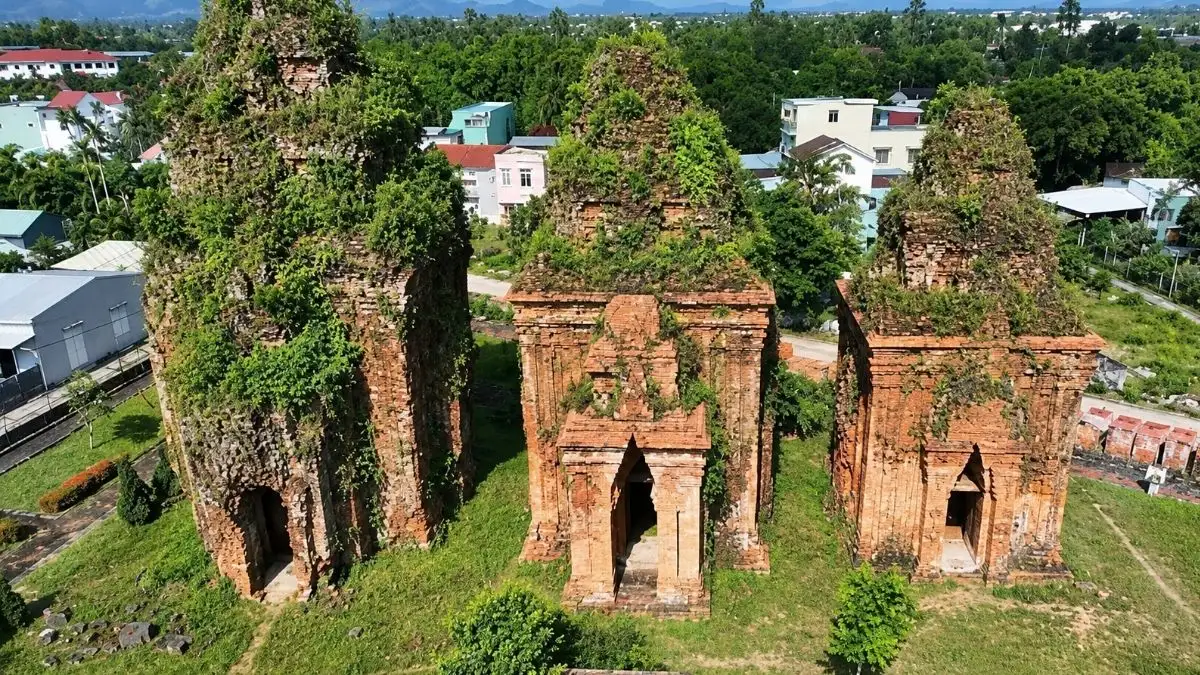
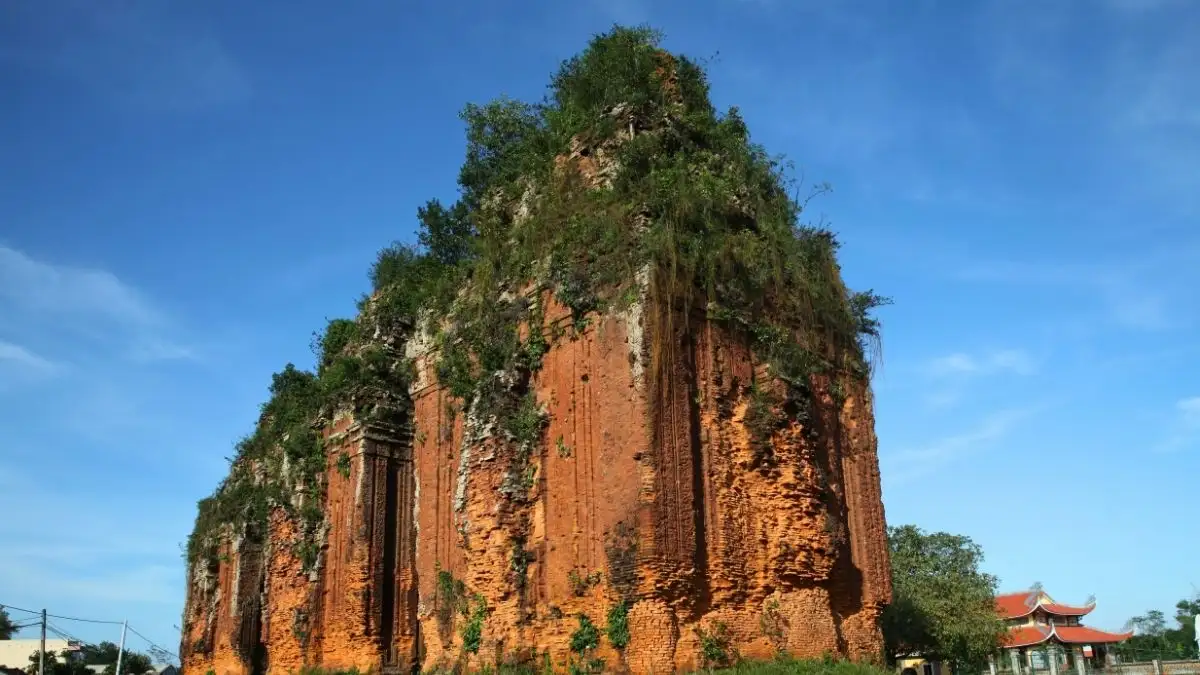
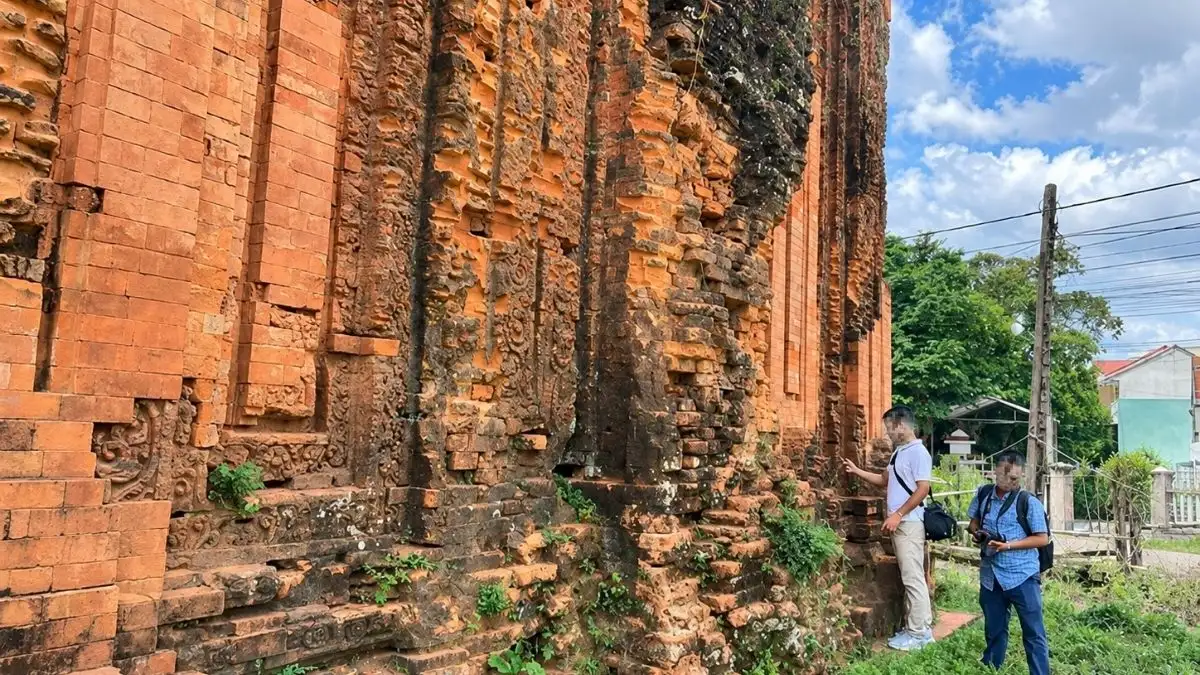
Built in the late 9th to early 10th century, the Khuong My Cham complex has survived wars, storms, and over a thousand years of tropical weather largely intact, which is what draws archaeologists here more than casual sightseers. The three towers are arranged on a north-south axis, a classic Cham layout: nearly square floor plans, entrances facing east, and three-tiered roofs where each tier is a smaller echo of the one below, capped with a sandstone finial.
Stand close to one of the towers and the real puzzle becomes obvious. The entire structure is built almost solid, brick on brick, with barely enough hollow space inside for a single person to walk around and perform a ritual. There’s no mortar holding it together in the way modern brickwork uses cement, and yet, after a thousand years of monsoon rain, the towers show no sign of leaning or structural failure.
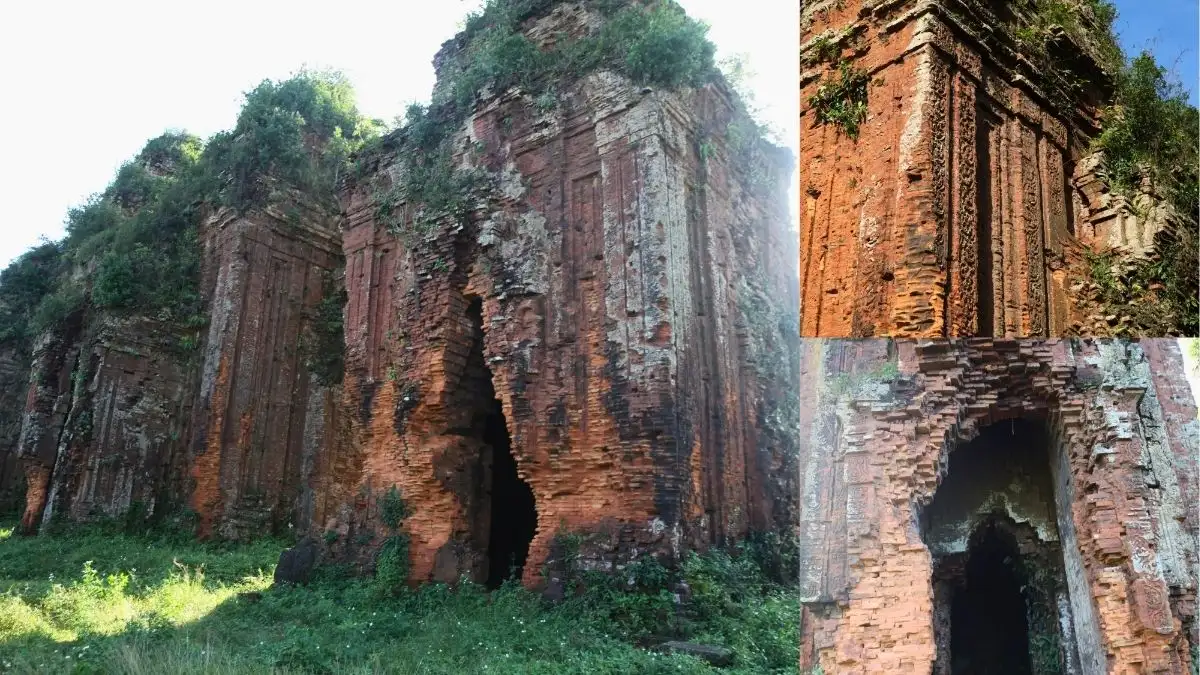
The mystery is in the brick itself. Archaeologists have never fully explained why Cham-era brick has this property: pour water on one face of a brick, and the water drains almost entirely out the opposite side, something ordinary modern brick simply doesn’t do. No one has reverse-engineered exactly how it was fired or bound, which is part of why researchers keep coming back to Khuong My rather than treating it as a solved case.
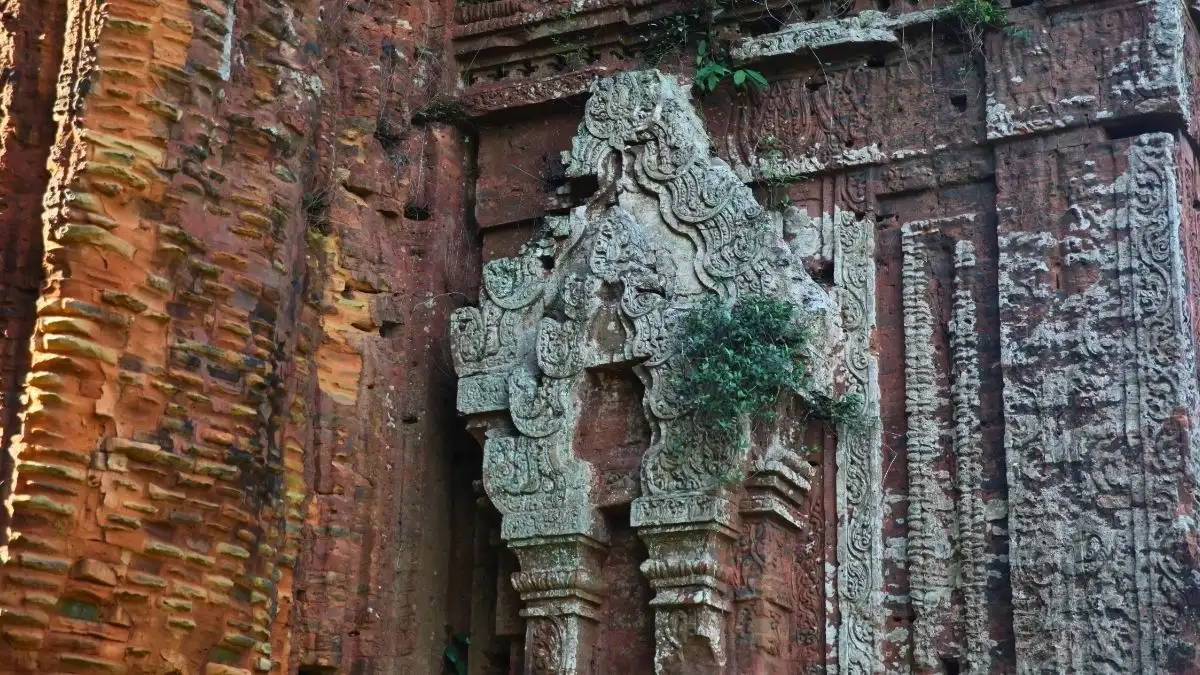
Each tower has one working entrance and five false doors, with the archways above them carved into curling, stylized foliage, the design tapers upward into a shape resembling a bodhi leaf at the peak of each arch, a recurring motif across the site. Compared to Cham towers further south in Binh Dinh, which tend toward sharp, deep carving, Khuong My’s decoration is notably softer and more fluid, distinctive enough that researchers classify it under its own label, the “early 10th-century Khuong My style.”
Inside the towers: architecture worth looking closely at
On each wall face, five decorative pilasters are carved with vine-like motifs curling into repeating S-shapes, alternating with diamond-patterned panels that run from the base of the wall to the top. Lower down, the base and body of the towers carry relief carvings, the mythical bird-god Garuda, the serpent Naga, riders on elephants and horses, and monkeys, imagery connected to the Ramayana, the Indian epic that shaped Cham religious art through Brahmanism.
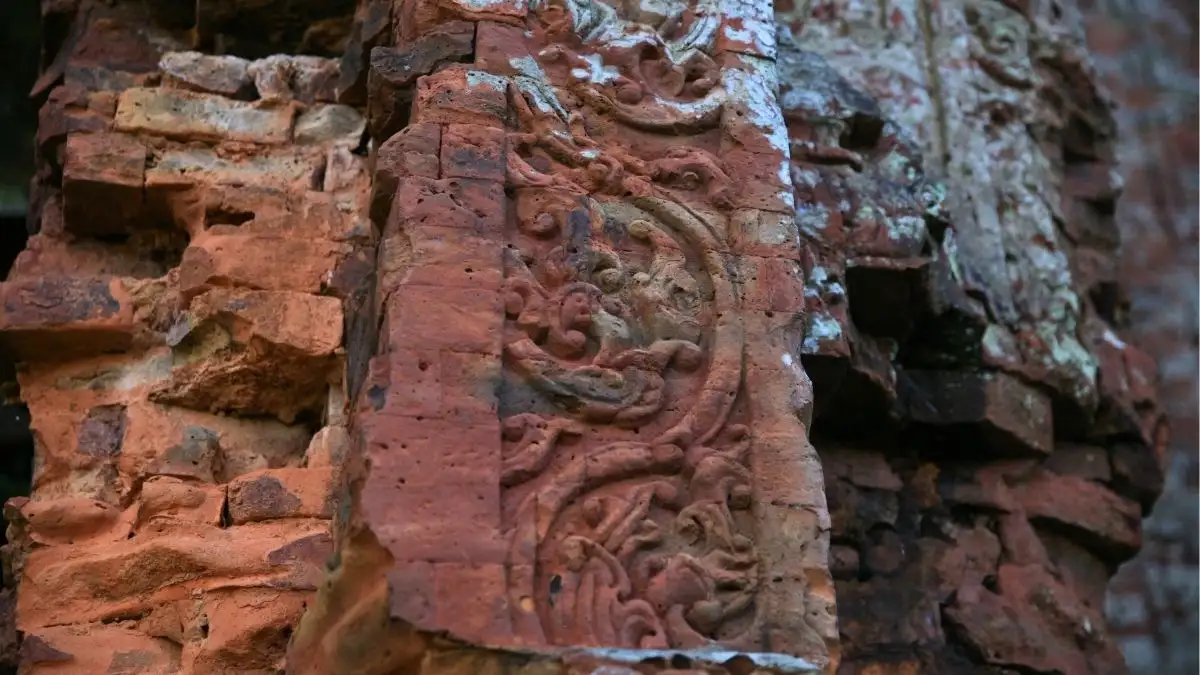
The central tower was originally dedicated to Shiva, with the two flanking towers dedicated to Brahma and Vishnu, the same triad found across much of Cham temple architecture (Source: Bao Tuoi Tre). Most of the smaller sculptural pieces excavated from the site aren’t on view here anymore; they’ve been moved to the Museum of Cham Sculpture in Da Nang, which is worth a stop if you want to see them up close. In front of the towers, archaeologists also found the remains of a gopura (gate structure), and nearby stands the tomb of Tran Van Du, a 19th-century leader of the Nghia Hoi Quang Nam resistance movement – a smaller but locally meaningful historical layer on top of the Cham ruins themselves.
Khuong My Towers is better approached as a quiet historical stop than a major attraction. Visitors often find that the details of the Cham carvings are much easier to appreciate in person than in photos. If you are genuinely interested in Champa culture, consider combining Khuong My with Chien Dan Towers and My Son Sanctuary to make the most of a full day exploring Cham heritage sites.
Read more: My Son Sanctuary Vietnam – Champa cultural heritage
Practical info: Khuong My Cham hours, tickets, and getting there
- Entrance fee: Free
- Opening hours: 7:00 AM – 5:00 PM daily
- Address: Tam Xuan commune (formerly Tam Xuan 1), Da Nang City (formerly Quang Nam province), about 1 km east of central Tam Ky, across the Tam Ky River
- Distance from Hoi An: ~50 km, roughly 2 hours by car or motorbike
- Getting there: There’s no public bus route direct to the site. Most visitors go by private car, taxi, or motorbike via QL1A. If you don’t want to drive yourself for 4 hours round-trip, arranging a private car for the day is worth the cost, especially if you’re combining it with My Son or Chien Dan Towers on the same route south.
Important notes before visiting:
- On-site guidance: The site is typically unstaffed, so don’t expect a caretaker or guide. Bring some background reading or travel with a driver who knows the history.
- Chien Dan Towers: Generally open on the same day and worth the extra 20-minute detour, as it sits conveniently between Tam Ky and the Khuong My site.
- Avoid rushing the itinerary: With no ticket booth or set tour infrastructure, it’s easy to underestimate the travel time and combine the site with a full My Son Sanctuary visit. Seeing both properly can make for a very long day, so allow a full day rather than treating it as a half-day add-on.
Where to stay before your Cham heritage day trip
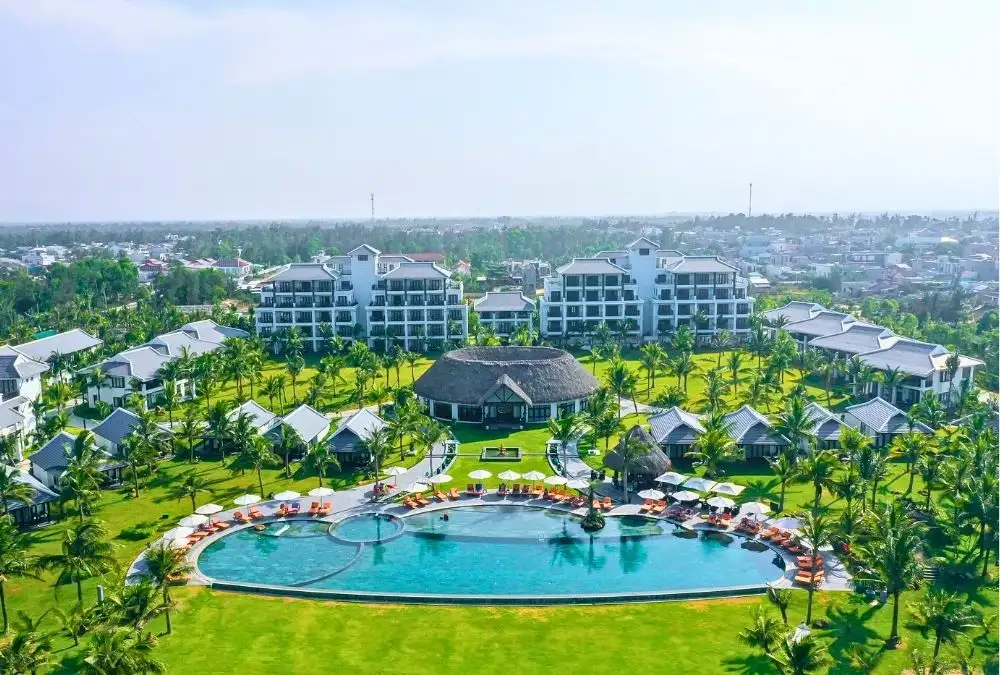
A day spent tracking down 1,000-year-old brick towers is a long one – most of it on the road – which makes where you start and end that day worth thinking about. Bliss Hoi An Beach Resort & Wellness sits right on Binh Minh Beach, with 135 rooms across 8 categories and an infinity pool looking straight out over the water, a good base for an early departure and a well-earned rest afterward.
If you’re staying at the resort, the front desk can help arrange a private car for the Khuong My-Chien Dan-My Son route, so you’re not negotiating taxi fares roadside. And after a day of dusty ruins and long drives, coming back to a treatment at the on-site wellness spa or dinner at Binh Minh Restaurant is a far better way to end the day than another restaurant search in an unfamiliar town.
Ready to plan your trip? Book the My Son Sanctuary Tour directly with the resort, or reach out to the team if you’d like help building a full day around Hoi An’s lesser-known Cham history.

Frequently Asked Questions
Is Khuong My Cham worth visiting if I’ve already seen My Son Sanctuary?
→ Yes, Khuong My Cham has a different, softer decorative style than My Son and is far less crowded, since it sees a fraction of My Son’s tourist traffic. If you only have time for one Cham site, though, My Son’s larger scale makes it the better single choice.
Do I need a guide to visit?
→ Not necessarily. The site is small and free to enter, but a guide or some background reading helps explain its history and the brickwork.
Can I combine this with other Cham sites in one day?
→ Yes. Chien Dan Towers lies between Tam Ky and Khuong My, and both can be combined with My Son Sanctuary if you start early and arrange a private car.
Is the area still called Quang Nam?
→ Administratively, no. Quang Nam merged with Da Nang City in July 2025, although “Quang Nam” is still widely used in older materials and travel searches.

Related Posts
Hoi An to Mui Ne: 3 Routes Compared for Travel, Scenery and Adventure
Hoi An Indochine Style Resort: How to Choose a Stay With Real Vietnamese Character
Private Chef Hoi An: Top 10 Chefs for a Personalised Dining Experience
A trip from Hoi An to Tam Ky in one day: Is it feasible?
Private Tours from Hoi An Beach Resorts: Discover Central Vietnam from Bliss Hoi An