

Hoi An Old Town Tourist Traps: What to Watch Out For
Hoi An Old Town is not necessarily a tourist trap, but some situations can leave visitors overcharged or pressured into buying something they did not ask for. The key is knowing the difference between a normal tourist price and a situation where you lose the freedom to say no. This guide breaks down the common Hoi An old town tourist trap and how to avoid them.
Is Hoi An old town tourist trap?
No, Hoi An is not a tourist trap overall, but some parts of the tourist experience can feel like one. Most visitors expect some sellers to approach them, offer extra services, or suggest certain shops. That is not necessarily a problem as long as you can say no and walk away freely. The problem starts when that freedom becomes harder to exercise when facing a Hoi An old town tourist trap.

A common example is a cheap group tour that takes visitors to a specific shop. The guide may receive a commission for bringing the group there, so the shopping stop becomes part of the itinerary. Once inside, visitors may be asked to sit through a product presentation in a closed, air-conditioned space that can be surprisingly difficult to leave without buying something. The products may also cost much more than similar-quality items elsewhere, while the pressure of being with a group makes it harder to simply stand up and leave.
The problem is not the act of selling itself. It is the combination of limited freedom to leave, pressure to buy, and a high price that is difficult to negotiate once you are already there. That is what separates a genuine Hoi An old town tourist trap from normal tourist-area commerce.
5 Common tourist traps in Hoi An
Airport taxi and transport scams
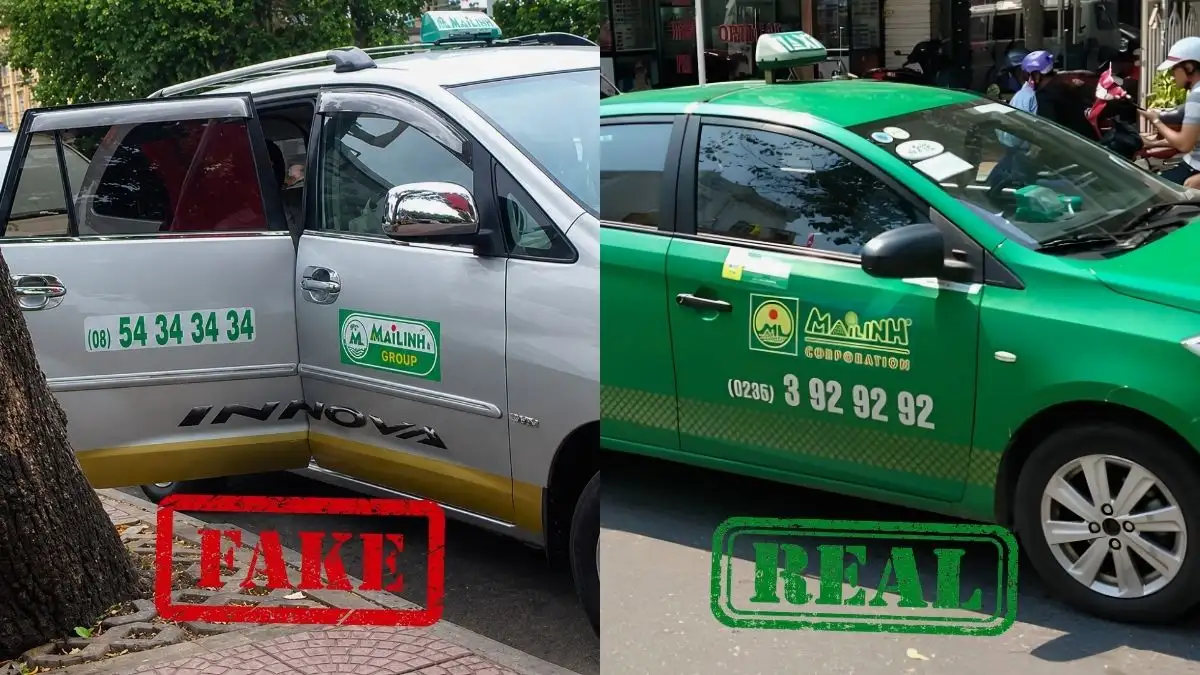
The trouble can start before you even reach Hoi An Old Town. Metered taxis are usually the safer choice, but unofficial taxis and private cars without meters can still operate around airports and bus stations. They may look like regular taxis, but instead of using a meter, the driver charges a negotiated fare, which can be difficult for first-time visitors to judge. Choosing recognized companies such as Mai Linh (green livery) and Vinasun (white and red) is a safer option, as both use metered fleets and clearly display their names on the vehicles.
Parking fees around the Old Town can also vary. The official posted rate for car parking is 30,000 VND per visit, but visitors have reported paying 40,000-50,000 VND at some private lots. In isolated cases, charges as high as 100,000 VND have also been reported (Source: VietnamNet). To avoid unexpected charges, check the official or posted fare before paying and ask about the price if it is higher than expected.

For a private transfer, a pre-booked car from Da Nang Airport to Hoi An typically costs around 250,000-350,000 VND, depending on the vehicle and booking service. Agreeing on the price before the ride helps avoid negotiating after arrival. Booking through your accommodation or a ride-hailing app can also make the journey more predictable. Our guide to using the Grab app in Hoi An explains how to book an airport ride and check the fare in advance.
Forced shopping stops on cheap group tours
Some cheap group tours include shopping stops that are not really optional. The tour may look like a good deal, but the guide can earn a commission by bringing the group to certain shops. Once there, visitors may be taken into an enclosed space for a sales presentation, making it uncomfortable to leave without buying anything and turning it into a Hoi An old town tourist trap.

Tailor shops are a common example. A suit sold in the Old Town can cost around 7.5 million VND, while a suit of similar quality from a shop at 1 Tran Phu Street, outside the main tourist area, costs about 4.2 million VND (Source: Bao Tuoi Tre). The difference shows why it is worth comparing prices instead of buying from the first shop recommended during a tour.

Drivers, tuk-tuk operators, and even hotel staff may also receive a 15-25% commission for sending customers to a particular tailor. To avoid this, choose a tailor yourself after checking independent information, and ask whether a tour includes any mandatory shopping stops before booking.
Read more: 15+ best places to shop in Hoi An: A local’s shopping guide (2026)
Aggressive sellers and unsolicited services
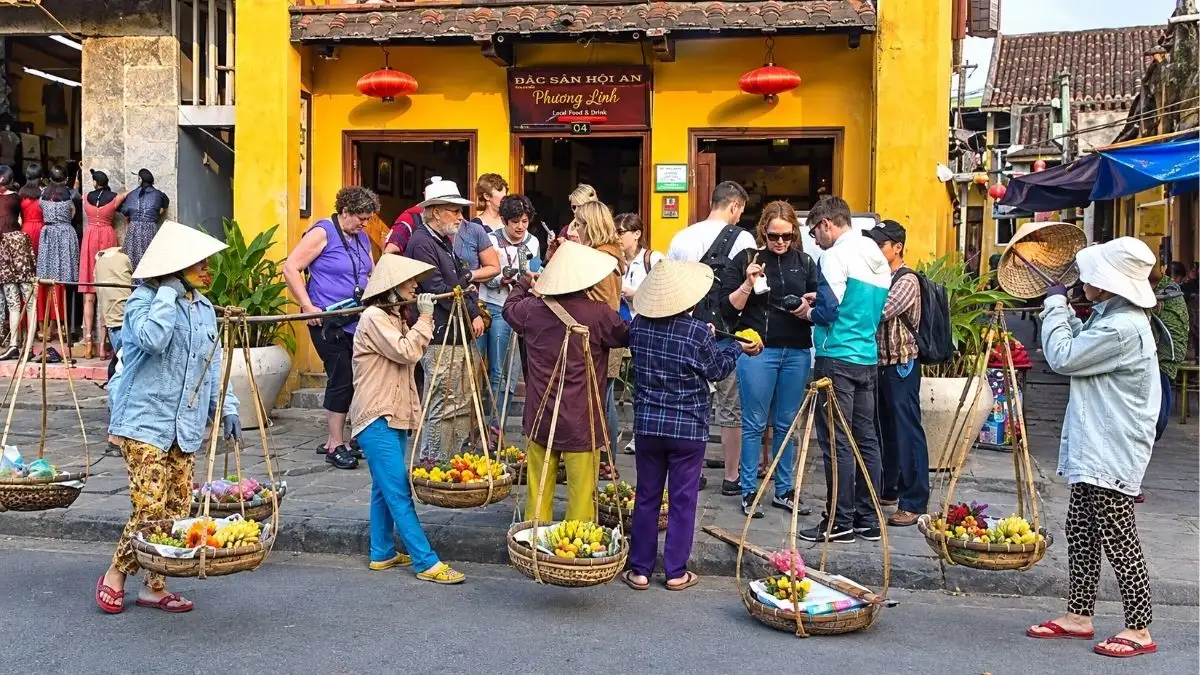
Walking through Hoi An Old Town, you may be approached by vendors offering conical hats, fruit, boat rides, or simply asking you to “take a look.” This is not necessarily a scam, but repeated offers can become uncomfortable. A clear “No, thank you” said early is usually enough. If you stop, make eye contact, or start discussing the offer, the interaction may continue for longer and risk becoming a Hoi An old town tourist trap.

A more common problem is being charged for a service you did not clearly agree to. Shoe shiners, shoulder massage sellers, and photographers may sometimes start before telling you the price. One traveler, for example, was asked to pay around 200,000 VND after taking a quick photo with a fruit basket, while another was charged a similar amount after buying a small amount of fruit from a shoulder-pole seller near the river.
The safest rule is simple: ask the price before a photo is taken, a shoe is touched, or any service begins. “How much before we start?” or “No, thank you” is usually all you need to say. If you want to avoid crowds and repeated offers, go early in the morning after sunrise, before tour groups arrive and the streets become busier.
Unclear pricing and overpriced food/drinks
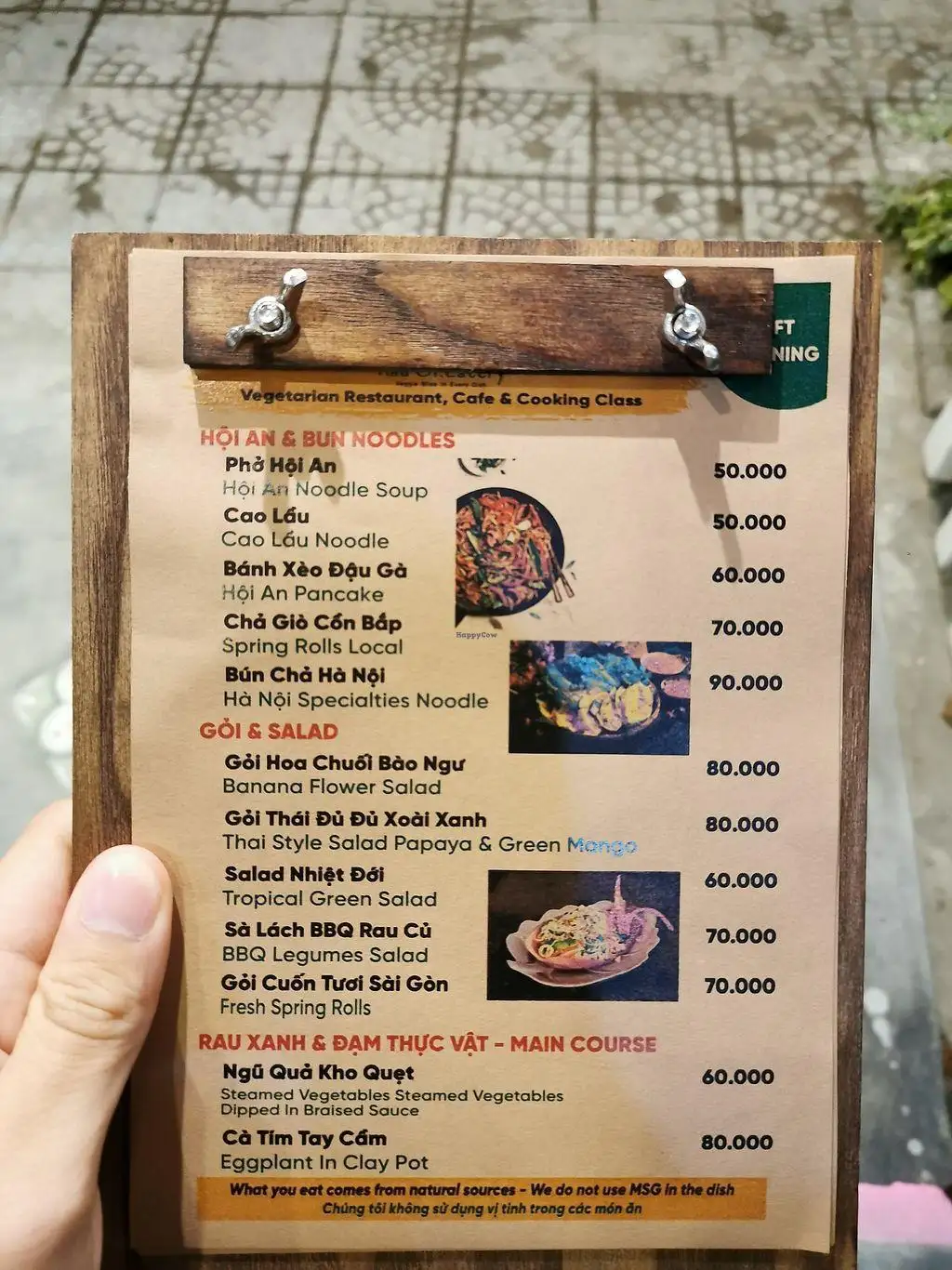
Food in a tourist area will not always cost the same as food in a local neighborhood. A restaurant by the river may charge more for its location and that is not necessarily a tourist trap. The real warning sign is unclear pricing, especially when there is no menu, no price displayed, and you only learn the cost after ordering.
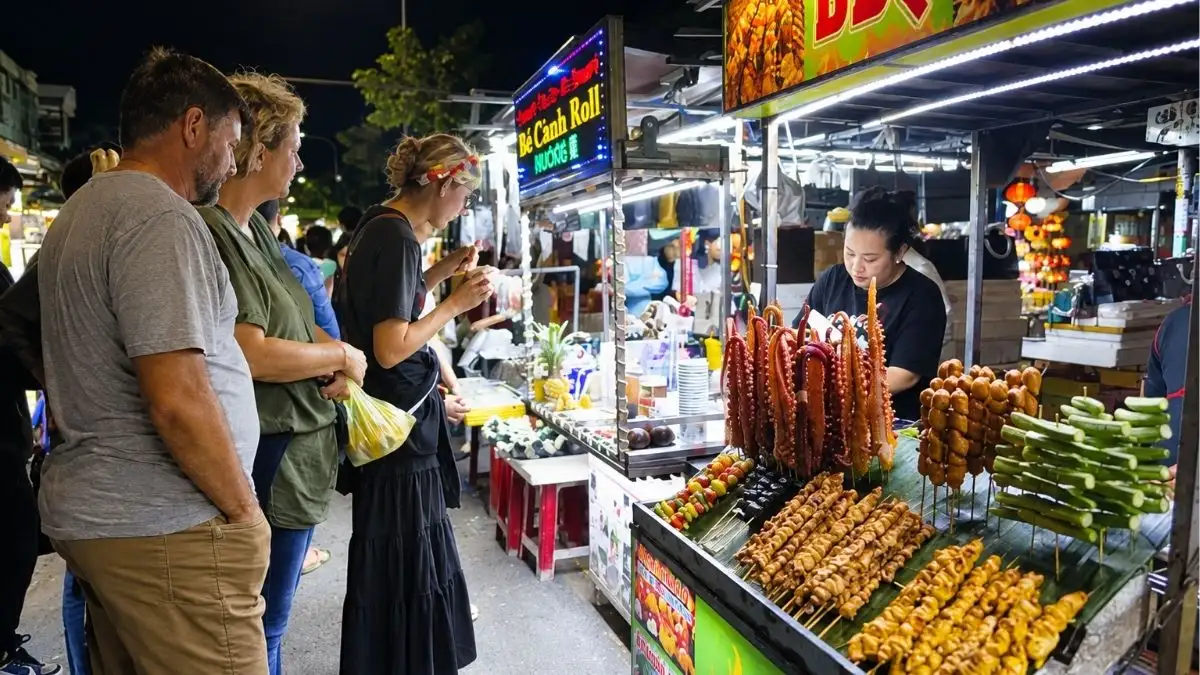
Having a few typical prices in mind makes it easier to spot an unreasonable charge:
| Food or drink | Typical price |
| Banh mi | 15,000-40,000 VND |
| Chicken rice | 30,000-35,000 VND |
| Fresh sugarcane juice | Around 18,000 VND |
| Iced tea at night market stalls | 20,000-30,000 VND |
| Sit-down meal in the Old Town | Around 200,000 VND/person |
These are only rough benchmarks, not fixed prices. Always check the price before ordering, and walk away if a seller refuses to give you a clear price. If you would rather have a local guide take you to tried-and-tested food spots, Bliss Hoi An also offers a Hoi An Street Food Tour where you can explore local dishes without having to navigate food stalls and prices on your own.
Fake or manipulated reviews
A high five-star rating does not always mean a shop, tour operator, or restaurant is genuinely good. There are two common warning signs: fake reviews that use generic five-star comments, and businesses asking customers to leave a five-star review before they leave, sometimes in exchange for a small discount or free item.
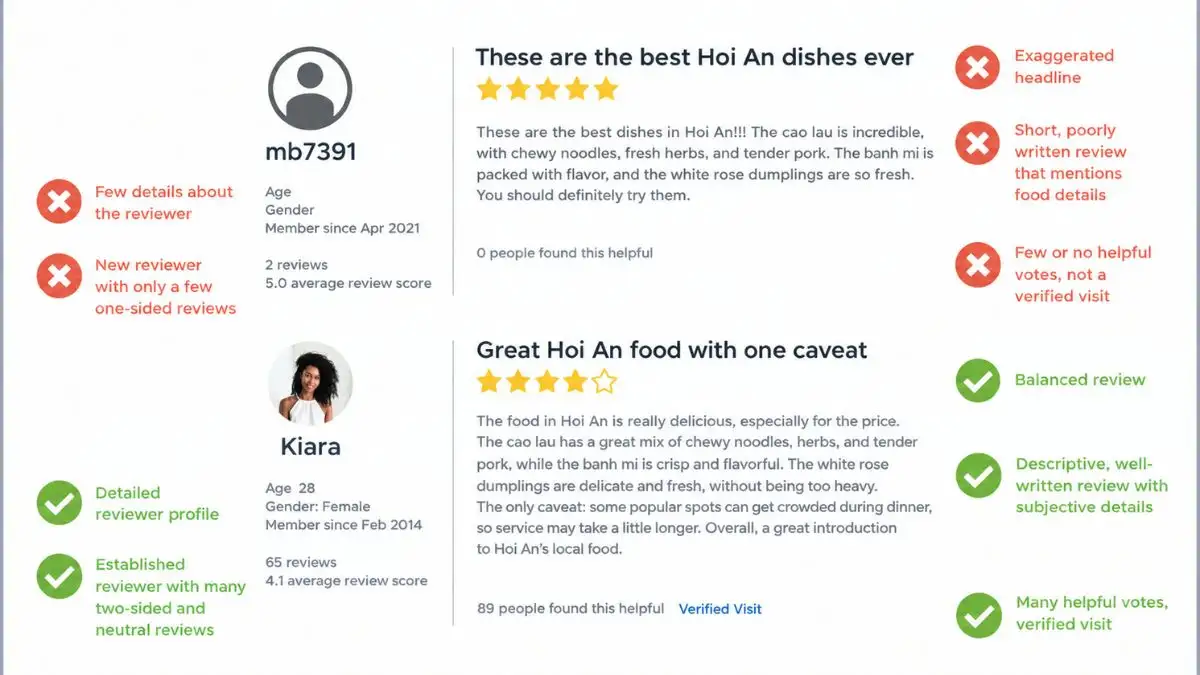
Instead of looking only at the overall rating, check the review pattern:
- Look for photos: Reviews with real photos are generally more useful than text-only reviews.
- Check the dates: A sudden burst of five-star reviews within a few days or a week can be suspicious.
- Read some three-star reviews: These often give a more balanced picture, including both good and bad points.
- Look for specific details: Reviews mentioning the actual service, price, fitting, fabric, or delivery time are more useful than repeated comments such as “amazing service” or “highly recommended.”
This is especially useful when choosing a tailor in Hoi An, where quality can be difficult to judge from photos alone. A review that mentions a second fitting three days later, the fabric used, or the final price gives you more useful information than a perfect five-star score by itself when spotting a Hoi An old town tourist trap.
What counts as a tourist trap vs. normal tourist pricing
The easiest way to tell the difference is to ask yourself what happened before you paid. A higher price alone does not make something a tourist trap. What matters is whether you had enough information to make a choice when identifying a Hoi An old town tourist trap.
| Normal tourist pricing | Potential tourist trap |
| The price is clearly shown before you order or use the service | The price is not given until after the service |
| A restaurant charges more for a river view, central location, or a more comfortable setting | You are charged much more than expected with no clear explanation |
| A transport fare is posted or agreed on before the trip | The driver changes the price or adds unexpected charges after the journey |
| You can compare the price and simply choose another option | You feel pressured to buy, stay, or continue once the interaction has started |
| The service is offered, but you are free to say no | A service starts without your clear agreement, such as a shoe shine or photo |
A useful rule when exploring Hoi An is never feel obliged to continue simply because you have already started. If a price, service, or tour arrangement feels different from what you agreed to, ask questions or walk away. Paying a little more for a convenient location or better service is normal; paying because you were given no clear choice is what should make you cautious.
How to avoid tourist traps in Hoi An
Choosing a tour
Ask directly whether the itinerary includes any shop stops before booking. A useful question is, “Does this tour include any compulsory shopping stops or visits to specific shops?” If the answer is vague, such as “we’ll stop somewhere special,” ask where the stop is, how long you will stay, and whether you are expected to buy anything. If you want a sightseeing-focused day, choose an itinerary that clearly lists its attractions rather than one that leaves shopping stops unexplained.
When shopping for tailoring or larger purchases
Research shops independently in advance rather than accepting a recommendation from a driver, tuk-tuk operator, or hotel staff member you did not specifically ask. Before ordering, check the shop’s recent reviews, look at examples of finished work, and ask about the fabric, alterations, delivery time, and total price. For custom tailoring, avoid paying the full amount before confirming what is included and when the finished items will be ready.
When paying for food or drinks
Choose stalls and restaurants with visible, posted prices, and simply ask before ordering anywhere that does not have one. For items sold by weight, portion, or size, ask “How much is this portion?” before it is prepared. If the price changes after ordering, clarify the amount before continuing rather than waiting until the bill arrives.
When reading reviews
Prioritize reviews with photos and a spread of dates, and be skeptical of a shop with only recent, uniformly five-star feedback. Look for specific comments about prices, service, product quality, and whether the experience matched what was advertised. A large number of reviews is less useful if they contain almost no detail about the actual experience.
A stay somewhere with a team that already knows these patterns can also take some of the pressure off. At Bliss Hoi An Beach Resort & Wellness, guests can ask the team for practical recommendations on where to go and how to arrange their day before heading into the Old Town. If you prefer to explore Hoi An with a planned itinerary rather than negotiate with individual sellers or operators along the way, Bliss Hoi An’s city tour is another option to consider. See the Hoi An City Tour and ask the team about the current itinerary before booking.

FAQs
Is Hoi An safe for tourists?
Yes, generally. Most Hoi An old town tourist trap involve overcharging or pushy sales rather than personal safety.
Are Hoi An tailors a scam?
Not inherently. Research the shop independently and be cautious with recommendations from drivers or tour operators.
How do I avoid shopping stops on Hoi An tours?
Ask before booking whether the tour includes shop visits, and check recent reviews for mentions of unwanted stops.
Is it normal to bargain in Hoi An?
Yes, especially at markets and stalls without posted prices. Bargaining is less common at restaurants and shops with fixed prices.

Related Posts

Cau Bong Festival in Hoi An: Inside Tra Que’s Agricultural New Year Tradition

Top 8 things to consider for a wedding in Hoi An with 20 guests

Best Beach Resort in Hoi An: Top 7 things to avoid when choosing to stay

4 Hoi An wedding packages compared: Which one is right for you?

5 mistakes to avoid when self-driving from Hoi An to Quang Ngai in a day