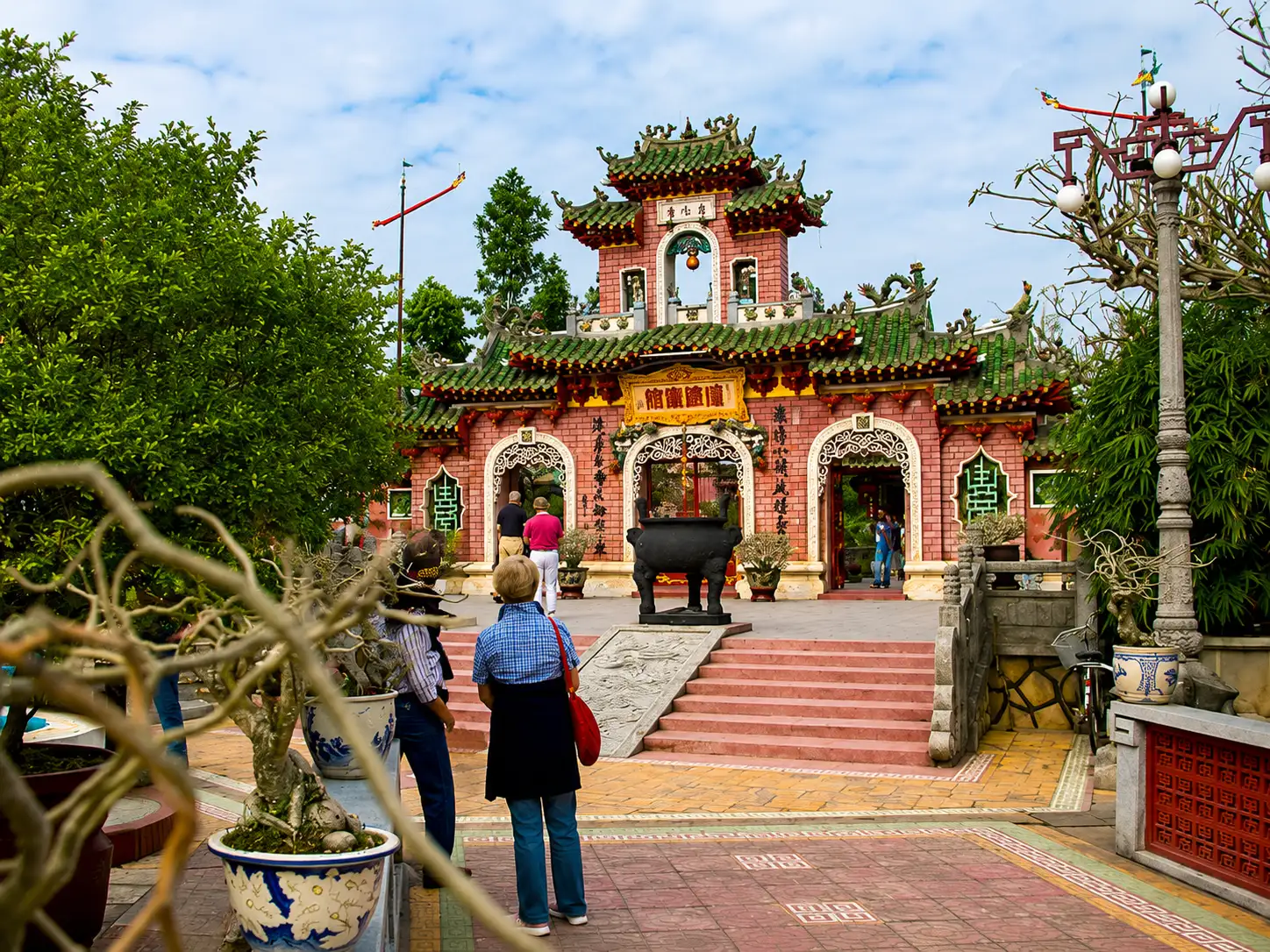
Quan Cong Temple: Hoi An’s most sacred temple
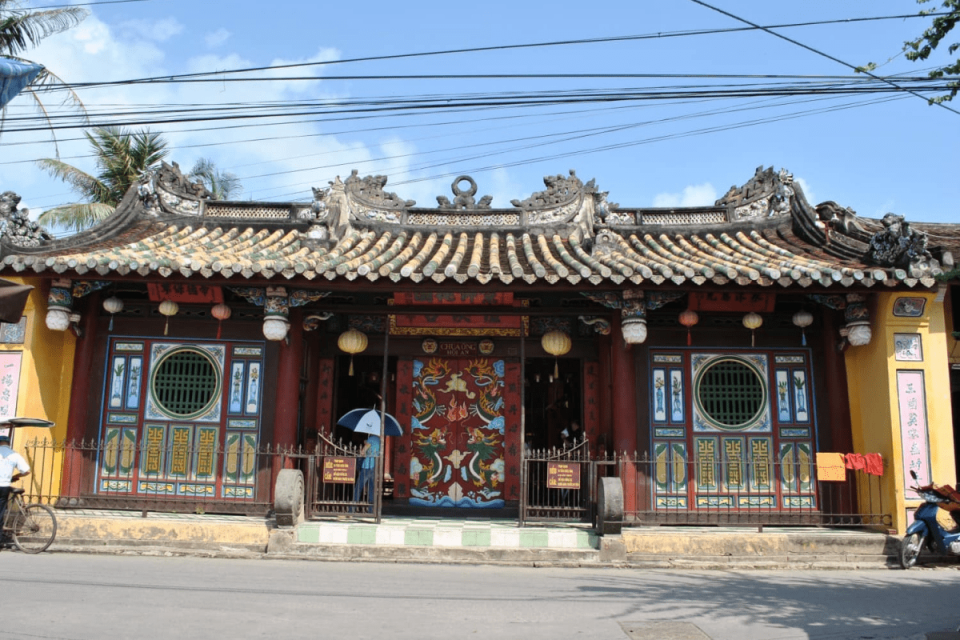
Among the prominent relics of Hoi An ancient town, Quan Cong Temple is one of the must-see places. Built in the 17th century, this temple is a place to worship the famous general Quan Vu, containing historical and cultural stories. International tourists should visit Quan Cong Temple once to feel the peaceful, solemn atmosphere and explore the unique cultural values of this ancient temple.
About Quan Cong temple
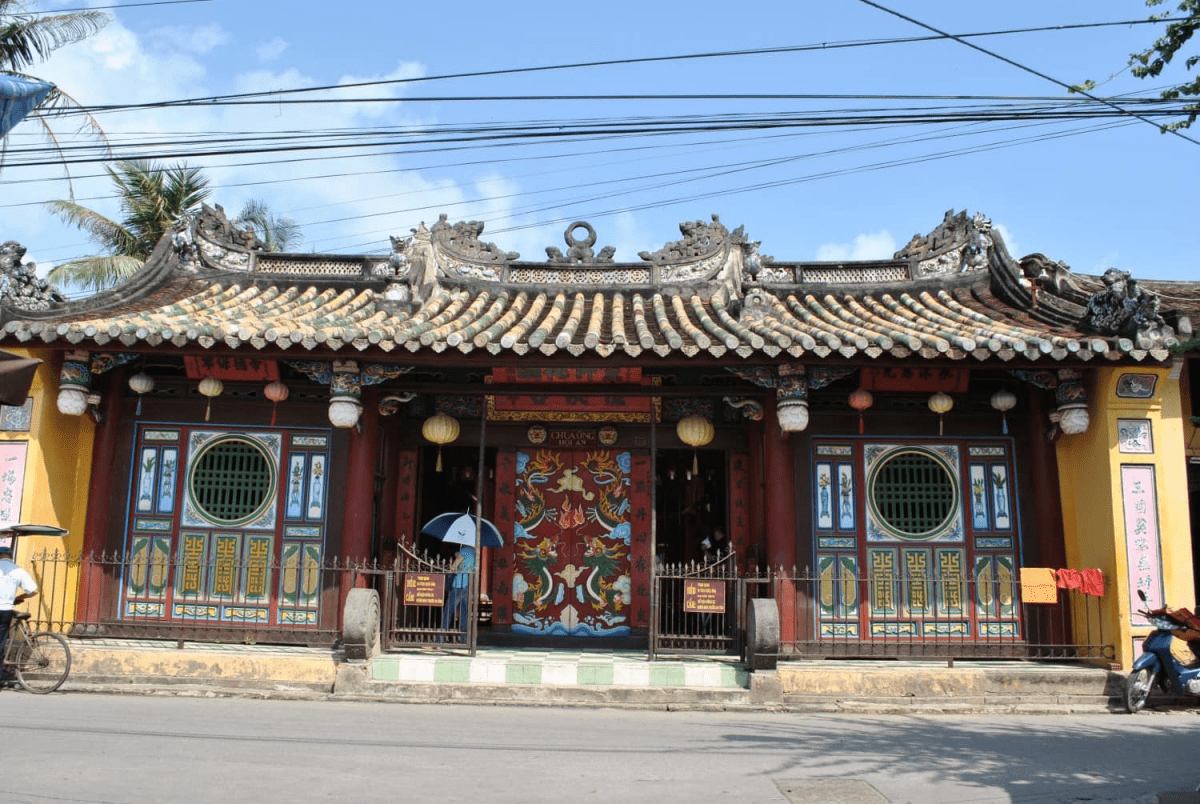
Quan Cong Temple, also known as the Cantonese Assembly Hall in Hoi An, is one of the most significant cultural and spiritual landmarks located in Hoi An Ancient Town. The temple was built to honor Quan Yu (Quan Cong), a legendary general from China’s Three Kingdoms period, who is widely revered across East Asian cultures as a symbol of loyalty, righteousness, and integrity.
Quan Yu is not only remembered for his military talent but also for his strong moral character and unwavering sense of justice. Over time, his image has transcended history and evolved into a powerful spiritual figure worshipped by Chinese-Vietnamese communities and people across the region.
In the spiritual life of local people in Hoi An, Quan Cong Temple plays an important role as a place to pray for peace, good fortune, and protection in both personal life and business. It is especially popular among traders and entrepreneurs who believe in Quan Cong’s blessing for fairness and success.
Today, Quan Cong Temple is not only a religious site but also a major cultural and historical attraction. Its well-preserved architecture, sacred atmosphere, and the cultural blend of Vietnamese and Chinese heritage make it one of the most visited landmarks in Hoi An Ancient Town.
Where is Quan Cong Temple located?
Quan Cong Temple is located right in the heart of Hoi An Ancient Town at 24 Tran Phu Street, Minh An Ward, Hoi An City, Quang Nam Province (now part of Hoi An Ward, Da Nang City after the latest administrative reorganization).
From the central area of Hoi An Ancient Town, getting to Quan Cong Temple is very easy as it is within walking distance. If you start from the famous Japanese Covered Bridge, it takes only about 3–5 minutes on foot (around 300–400 meters) along nearby streets such as Nguyen Thi Minh Khai or Tran Phu to reach the temple. If you depart from the Hoi An Central Market, the walking distance is also short, approximately 5–7 minutes on foot (around 500–600 meters), making it convenient to combine the visit with other attractions in the old town.
If you are staying in outlying areas such as Cam Chau, Cua Dai, or An Bang Beach, you can travel to the Ancient Town by motorbike, taxi, or ride-hailing services. The journey typically takes around 10–20 minutes, depending on your exact location. Once you arrive near the old town, vehicles are restricted, so you will need to park at designated parking areas outside and then walk approximately 5–10 minutes to enter the heritage zone.
Thanks to its central location and compact street layout, Quan Cong Temple is very easy to find. Most visitors include it as part of a walking itinerary while exploring other nearby attractions in Hoi An Ancient Town.
Learn the history of Quan Cong Temple in Hoi An
Quan Cong Temple, also known as Ong Hoi An Pagoda, is one of the famous cultural and spiritual architectural works in Hoi An, Quang Nam. This is the place to worship Quan Van Truong, a talented and loyal general famous during the Three Kingdoms period in Chinese history. Quan Van Truong, also known as Quan Cong, is not only respected for his loyalty and bravery in battle, but also for his noble personality, loyalty and outstanding martial arts talent.
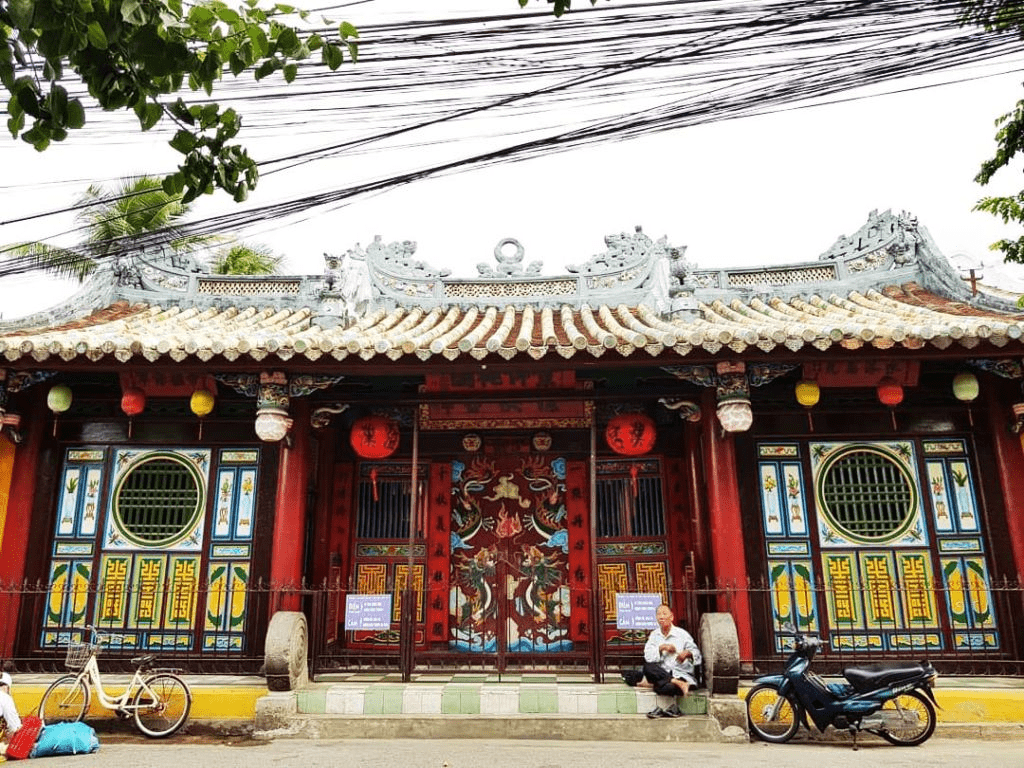
The temple was built in 1653 by Chinese immigrants to Hoi An, when this place was still a prosperous trading port and a major trading center of the region. Quan Cong Temple has a unique architectural style, highlighted by its colorful colors, bearing the traditional imprint of Chinese culture. The elaborate carvings, the majestic statue of Quan Cong, the dragon and phoenix motifs and the statues with spiritual meanings have created a solemn and majestic space of the temple.
Throughout its history, Quan Cong Temple has undergone many restorations and reconstructions in the 20th century, to preserve its beauty and cultural values. Currently, the temple has existed for more than 370 years, becoming an indispensable part of Hoi An’s cultural heritage complex. Local people and tourists often visit the temple to pray for health, peace and protection of Quan Cong.
With its important historical and cultural value, in 1991, Quan Cong Temple was recognized as a National Historical and Cultural Heritage. This affirms the importance of the temple in spiritual and cultural life, contributing to the preservation and promotion of this precious heritage for future generations. Today, Quan Cong Temple is not only a place of worship but also an important cultural and tourist destination, attracting thousands of visitors each year to worship and explore the beauty of history, architecture as well as the unique cultural traditions of Hoi An.
Explore Quan Cong temple’s architecture
Quan Cong Temple is one of the oldest and most iconic Chinese assembly halls in Hoi An, built in 1653 by the Cantonese merchant community. Over centuries of restoration, the temple has preserved its traditional architectural layout and artistic details, reflecting a strong blend of Vietnamese and Chinese cultural influences within Hoi An Ancient Town.
The overall structure follows the classic Chinese “Tam” (三) layout, with a straight axial design from the entrance to the main hall. This arrangement creates a sense of order, harmony, and gradual transition as visitors move deeper into the sacred space.
The first area is the main gate, which serves as the symbolic entrance to the temple. It features a traditional curved tiled roof decorated with intricate dragon motifs and ceramic ornaments. This gateway sets a solemn and sacred tone right from the beginning, leaving a strong first impression on visitors.
Beyond the gate is the courtyard (Thien Tinh space), an open-air courtyard located in the middle of the complex. This area allows natural light and ventilation to flow into the structure while creating a transitional buffer between the exterior world and the main sanctuary. From a feng shui perspective, it also plays an important role in balancing energy and maintaining harmony within the temple.
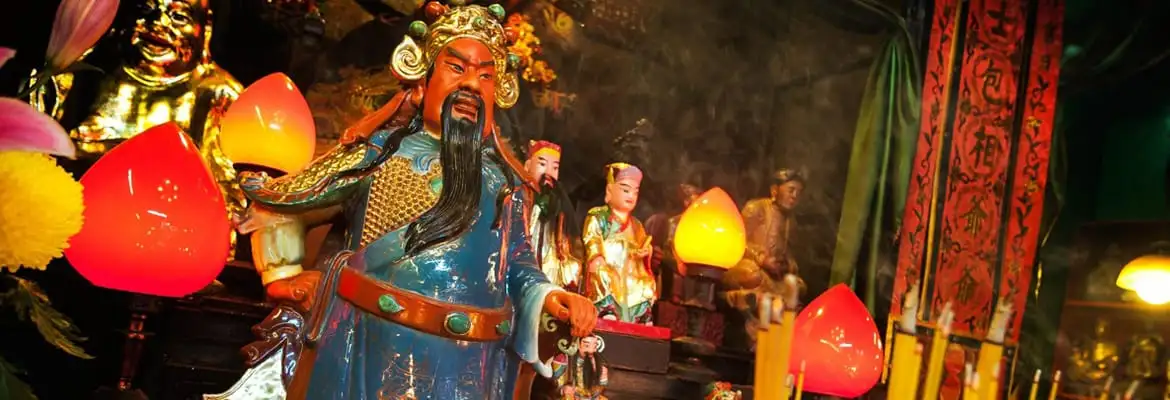
The most important area is the main hall, where the statue of Quan Cong is placed at the center in a highly revered position, lacquered in red and gold. On both sides are statues of Quan Binh and Chau Xuong, his loyal generals, who symbolize absolute loyalty and righteousness in East Asian culture. This space is considered the spiritual heart of the temple, where visitors come to offer incense and prayers for peace and protection.
In addition to its layout, the temple is distinguished by its traditional yin-yang tiled roof system, with softly curved corners and decorative elements such as dragons, phoenixes, and ceramic patterns. These details not only enhance the aesthetic value but also represent harmony and balance according to traditional feng shui principles.
The entire structure is built using traditional wooden frames combined with ancient brick walls. The dominant color palette of red, gold, and jade green creates a sacred yet visually striking atmosphere, typical of Chinese religious architecture from the 17th–18th centuries.
Furthermore, the temple features finely carved wooden panels, horizontal plaques, and calligraphy written in classical Chinese characters. These inscriptions emphasize core values such as loyalty, righteousness, integrity, and honor—qualities closely associated with the figure of Quan Cong.
Overall, Quan Cong Temple is not only a religious site but also a remarkable architectural heritage that reflects the historical presence of the Chinese community in Hoi An and contributes significantly to the unique identity of the Ancient Town today.
Read more: Explore Hoi An’s Cantonese Assembly Hall: A cultural gem
Antiques kept at Quan Cong Temple
Quan Cong Temple is one of the important historical relics, where many valuable antiquities are preserved, reflecting the culture and history of the nation through many generations. In particular, the antiquities here are not only valuable in terms of art but also have the meaning of honoring the long-standing traditional patriotism of the Vietnamese people. Some of the outstanding antiquities preserved at the temple include:
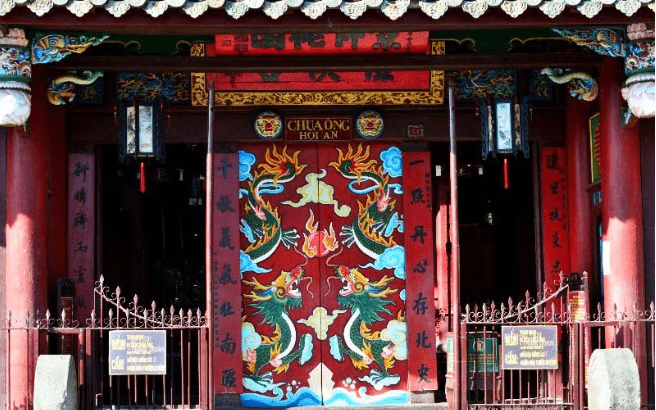
The noble titles
Throughout history, Quan Cong Temple has preserved many royal decrees from Vietnamese feudal dynasties. These royal decrees, despite hundreds of years, are still preserved intact, demonstrating the respect of previous generations for traditional cultural and spiritual values.
Horizontal plaques with Chinese characters
The horizontal lacquered boards hanging in Quan Cong Temple are unique works of art. Each horizontal lacquered board not only has high artistic value but also carries profound educational messages about morality and responsibility.
Fables of Nguyen Nghiem
Nguyen Nghiem – the father of the great poet Nguyen Du, left behind many valuable works in terms of literature and education. In Quan Cong temple, Nguyen Nghiem’s fables are preserved as part of the traditional cultural heritage. These stories have high educational value, guiding people to a life of integrity, honesty and responsibility.
Paintings by Uong Si Cu and Nguyen Lenh Tan
Two famous painters, Uong Si Cu and Nguyen Lenh Tan, left behind paintings of exceptional artistic value, which are preserved at Quan Cong Temple. Their works are not simply paintings depicting landscapes or people, but also contain profound thoughts about life and people. Each painting shows the sophistication in each stroke, reflecting the creativity and talent of the artists, and is also a testament to the development of the country’s fine arts.
Festivals and religious activities at Quan Cong Temple
Quan Cong Temple is one of the most important spiritual sites of the Chinese-Vietnamese community in Hoi An, where traditional rituals and ceremonies are held throughout the year. Among these, the most significant event is the Quan Cong Festival (Quan Cong’s Birthday Ceremony), which attracts both locals and visitors.
The festival takes place annually on the 24th day of the 6th lunar month, which corresponds to approximately early August in the Gregorian calendar. In 2026, it is expected to fall around 6–7 August 2026, although the exact date may slightly vary depending on lunar–solar calendar calculations and local practice. This event commemorates the birth of Guan Yu (Quan Cong), a highly revered historical figure in East Asian culture, symbolizing loyalty, righteousness, and integrity.
During the festival, the temple becomes lively yet deeply solemn, featuring traditional rituals such as incense offerings, ceremonial prayers, reading of ritual texts, and commemorative rites. Local residents, especially members of the Chinese community and merchants, visit the temple to pray for peace, good fortune, and success in business.
In addition to the main festival, Quan Cong Temple also hosts regular spiritual activities throughout the year, including Lunar New Year ceremonies, as well as offerings on the first and fifteenth days of each lunar month. Although smaller in scale, these rituals maintain a respectful and sacred atmosphere, reflecting the long-standing spiritual traditions of the local community.
Notes when visiting Quan Cong Temple
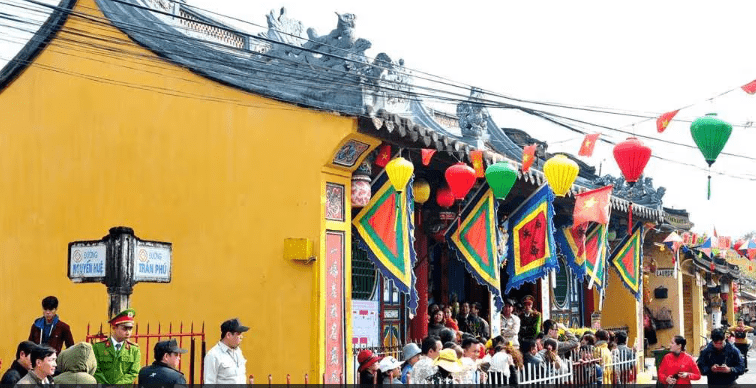
To preserve the purity and solemnity of the temple, visitors should note the following:
- Protect the spiritual space, do not talk loudly: Quan Cong Temple is a sacred place, where people often come to burn incense, pray and find peace. Therefore, talking loudly or making loud noises can affect this solemn space. Visitors should maintain a respectful attitude, speak softly, and if possible, limit talking in the temple area so as not to interrupt the serenity and concentration of others.
- Do not smoke or chew gum: Smoking and chewing gum are inappropriate behaviors in a religious and sacred space like Quan Cong Temple. Therefore, visitors should absolutely avoid these behaviors to show respect for the temple and the community space.
- Dress modestly and politely: When visiting Quan Cong Temple, visitors should pay attention to their clothing. Visitors should wear modest clothes, avoid revealing, too short or inappropriate clothing for the religious environment.
- Do not touch the artifacts: In Quan Cong Temple, there are many antiques and valuable artifacts preserved for hundreds of years. Therefore, visitors should absolutely avoid touching the artifacts, paintings or worship items to protect them from damage and scratches. People should only look and admire from a distance and respect the regulations of the temple management board.
Read more: Explore the beauty of Chaozhou Assembly Hall in Hoi An
Nearby attractions around Quan Cong temple worth visiting
Thanks to its central location in Hoi An Ancient Town, Quan Cong Temple is surrounded by many famous attractions that are easy to combine within a walking itinerary. Most sites are just a short distance away, making it ideal for a half-day exploration of the old town.
- Japanese Covered Bridge (Chùa Cầu): about 300–400m (3–5 minutes on foot) – the most iconic landmark of Hoi An, with over 400 years of history. It features a unique blend of Vietnamese and Japanese architecture and is one of the most popular photo spots in the town.
- Fujian Assembly Hall (Hoi Quan Phuc Kien): about 400–600m (5–7 minutes on foot) – well known for its grand ceremonial gate, spacious courtyard, and intricate dragon-and-phoenix decorations that highlight Chinese cultural influence in Hoi An.
- Cantonese Assembly Hall (Hoi Quan Quang Dong): about 300–500m (around 5 minutes on foot) – a beautifully preserved wooden structure with a solemn atmosphere, reflecting the spiritual life of the historic Cantonese merchant community.
- Sa Huynh Culture Museum: about 400–700m (5–10 minutes on foot) – home to ancient archaeological artifacts dating back thousands of years, offering deeper insight into the early history of Hoi An’s settlement.
- Hoi An Market: about 500–800m (7–10 minutes on foot) – a vibrant traditional market where visitors can enjoy local food specialties, shop for souvenirs, and experience daily local life after exploring the old town.
Hotel accommodation for travel to Hoi An ancient town

One of the most popular places to stay when visiting Hoi An is Bliss Hoi An Beach Resort & Wellness, a luxury beach resort located only about 17km from Hoi An city center. If you are looking for a hotel to stay, you should choose Bliss Hoi An Beach Resort & Wellness for the following reasons:
- Convenient location: Bliss Hoi An Beach Resort & Wellness is ideally located, just a short walk from the center of the old town to the resort. This makes it easy for visitors to explore the cultural and historical beauty of Hoi An during the day, and then return to relax in a peaceful space close to nature.
- Luxurious rooms with sea views: Bliss Hoi An Beach Resort & Wellness stands out with its luxurious, modernly designed rooms. What attracts visitors most is that all rooms have a view of the ocean, bringing a feeling of comfort and maximum relaxation.
- Diverse services, attentive customer care: In addition to the quality room system, Bliss Hoi An Beach Resort & Wellness also provides a variety of services, from spa, gym, luxury restaurants to beach entertainment activities. The resort pays special attention to service quality, with a team of enthusiastic, friendly staff, ready to support guests 24/7.
With the detailed information we provide about Quan Cong Temple, Hoi An above, we hope readers will have great experiences on their upcoming trip!

Related Posts

Things to Do Near Bliss Hoi An: A Practical Guide from Binh Minh Beach

What to Eat in South Hoi An: A Local Food Guide Beyond the Ancient Town
Common Mistakes When Visiting Hoi An With Elderly Parents

8 Common Mistakes That Can Ruin a Relaxing Holiday in Hoi An

Slow Travel in Hoi An: A Relaxed Family Guide for Every Generation