


Can You Take a Vietnam Sleeper Train Directly to Hoi An?

Yes, you can take a Vietnam sleeper train to Hoi An, but not all the way there. Since Hoi An has no train station, you’ll get off at Da Nang and continue by road. This guide covers the routes, sleeper cabins, ticket prices, refund rules and the final transfer to Hoi An.
Can a Vietnam sleeper train take you straight to Hoi An?
Yes, but you will need to travel one more leg after getting off the train. Hoi An has no railway station of its own, so sleeper trains stop at Da Nang Station, around 30 km from Hoi An. From there, you can continue by private transfer, taxi, or other road transport to reach the city.

This matters at the booking stage specifically. Search “train to Hoi An” on most ticketing platforms and you won’t find a matching station name at all, search “Da Nang” instead, and everything falls into place. You’re choosing a sleeper train to Da Nang, then handling one more short hop by road, and that second leg is short enough that it barely changes your overall travel time, covered in detail further down.
Which Vietnam Sleeper Train routes actually make sense for Hoi An?
Three main routes work well for travelers heading to Hoi An by train. The right option depends on where you start.
Hanoi to Da Nang
The Hanoi-Da Nang route takes around 14-16 hours, making an overnight sleeper train the most practical choice. You can board in the evening, sleep through most of the journey and arrive the next day without losing a full day to travel.
SE19 and SE20 are higher-standard trains on this route, launched in October 2023. SE19 leaves Hanoi at around 19:55 and reaches Da Nang at about 12:15 the next day. Fares start from around 943,000 VND on weekdays.
For the experience, expect a long but manageable night on board. A soft sleeper gives you more privacy and a proper bed, while a hard sleeper is cheaper but less comfortable for a full night. Bring earplugs and a light layer, as the air conditioning can feel cold overnight.
Ho Chi Minh City to Da Nang
The journey from Ho Chi Minh City to Da Nang is considerably longer, so a sleeper is particularly useful. Choose a train that arrives in Da Nang in the morning if possible, as this makes the onward transfer to Hoi An easier than arriving in the middle of the night.
This route is more about saving time than sightseeing. The long hours can feel tiring, but having a bed means you can sleep through much of the journey instead of sitting upright all day. Keep your essentials, phone and valuables close to your berth rather than storing everything in your main luggage.
Hue to Da Nang
The Hue-Da Nang journey takes only around 2.5-3 hours, so a sleeper berth is usually unnecessary. A soft seat is cheaper and lets you enjoy the coastal scenery, including the Hai Van Pass, where the train slows down for the views.
This is the most scenic of the three routes, so daytime travel makes more sense. Sit by the window if possible and keep your camera ready around the Hai Van Pass. For such a short journey, the train feels less like a way to sleep and more like a relaxed alternative to travelling by road.
How do you get from Da Nang Station to Hoi An?
Once you arrive at Da Nang Railway Station, you still have around 30 km to travel by road to Hoi An. The drive usually takes 45-60 minutes, but can take longer during busy traffic. If you have taken an overnight sleeper train, allow extra time to collect your luggage and find your ride rather than scheduling your next activity too soon.

There are three practical ways to continue:
- Grab: Best for solo travelers or two people with light luggage. Collect your bags first, then book through the app and follow the designated pickup point.
- Taxi: Available outside the station and convenient if you do not want to wait for a ride through an app. Confirm the fare or meter before leaving.
- Private transfer: A practical choice for groups, lots of luggage, or late arrivals. When booking, provide your train number, expected arrival time, number of passengers, and luggage. If the train is delayed, contact the driver and adjust the pickup time.
If you are staying at Bliss Hoi An Beach Resort & Wellness, you can book the resort’s transfer directly from Da Nang Railway Station. Bliss currently lists the transfer at 675,000 VND for a 4-seat car, 750,000 VND for a 7-seat car, and 900,000 VND for a 16-seat vehicle, including the driver and fuel. Pickups between 10 PM and 5 AM cost an additional 100,000 VND per trip, and the resort requires at least one hour’s advance booking.
For an overnight train, it is better to arrange the transfer before leaving your departure station rather than looking for a car after you arrive in Da Nang. Send Bliss your train details and keep the resort’s contact number in case the train runs late. That way, you can collect your luggage, meet your driver and head straight to the resort.
Read more: Hue to Hoi An by train: Scenic journey, travel tips & relaxing stay
What is a Vietnam sleeper train actually like inside?
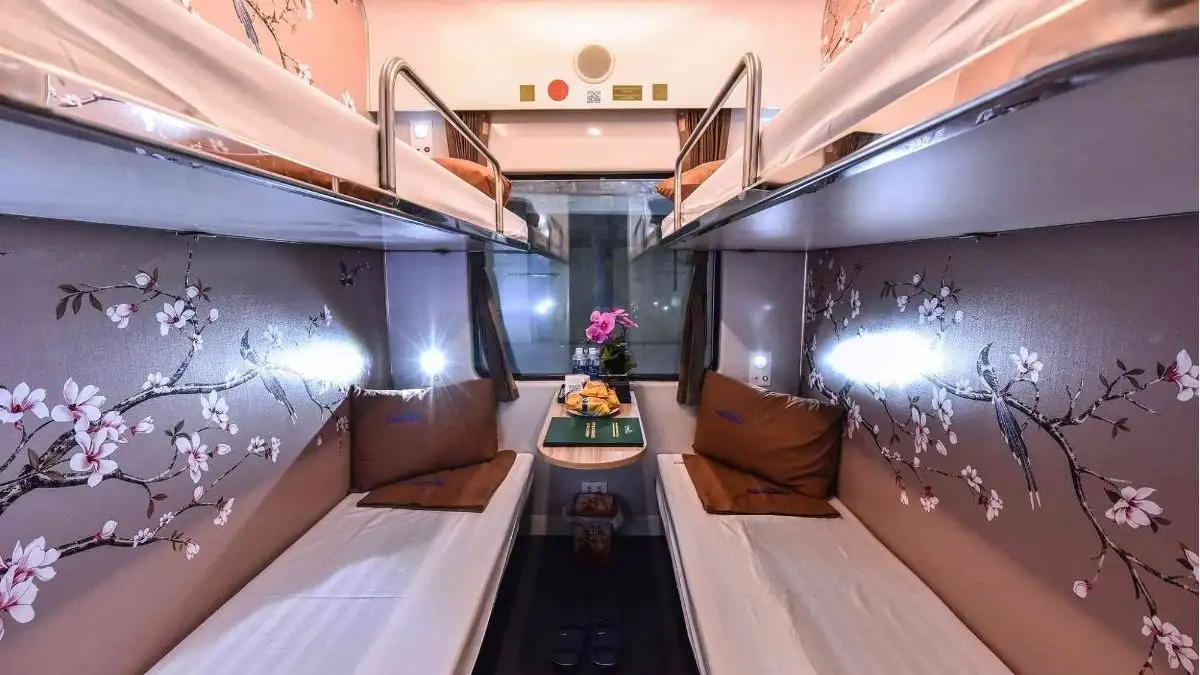
A standard soft-sleeper cabin has four berths, arranged as two upper and two lower beds facing each other. Each berth is roughly 80 × 190 cm, enough to lie flat but with limited space around you. Air conditioning is standard, and berths typically have a reading light and a small shelf for essentials such as a phone or water bottle.
Is a 4-berth cabin private?
A four-berth cabin has two upper and two lower berths. If you book only two beds, other passengers can take the remaining berths. This is normal on Vietnam sleeper trains and may mean sharing the cabin with people you have never met. If you are travelling as a family or group and want more privacy, check whether you can book all four berths in the same cabin.
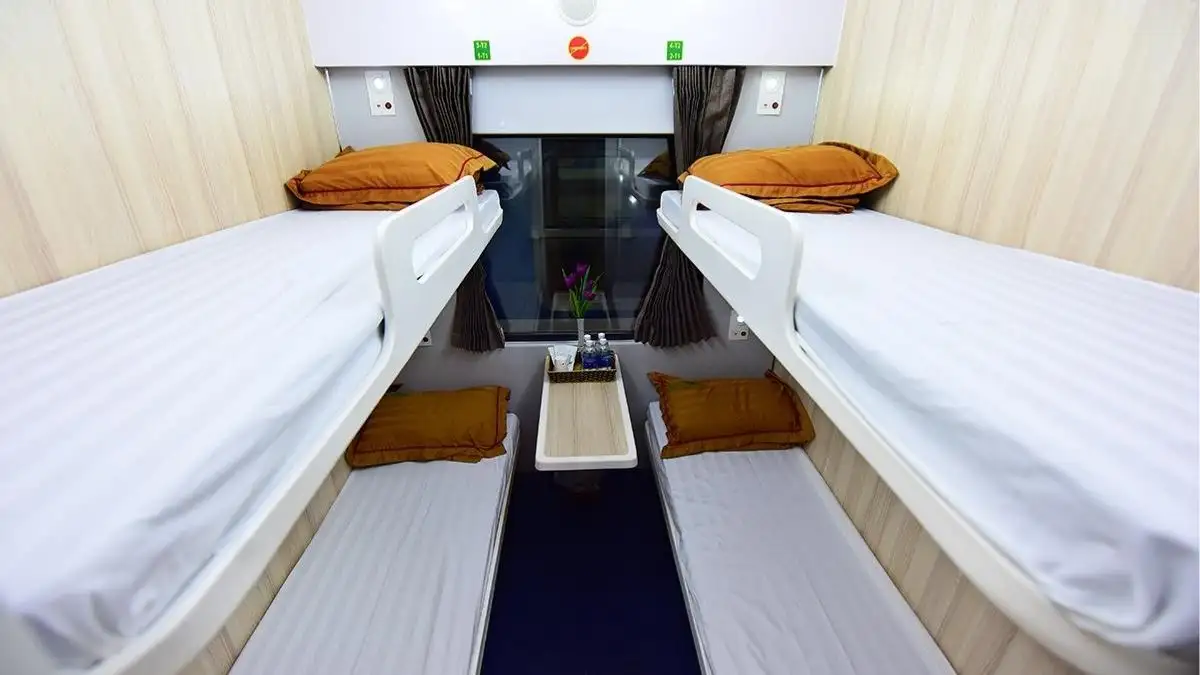
This also gives you more space to manage luggage. A large suitcase is easier to handle with a lower berth, while an upper berth leaves you with less convenient access to your belongings.
Should you choose an upper or lower berth?
Your berth position makes a noticeable difference on an overnight journey.
Lower berth:
- Easier to climb in and out.
- More convenient with large luggage.
- Easier to reach your belongings during the night.
- More exposed to people moving around the cabin.
Upper berth:
- Usually feels more private.
- Less affected by movement around the cabin.
- Harder to climb into, especially with luggage.
- Less convenient if you want to sit up.
If convenience matters most, especially on your first sleeper train, the lower berth is easier to manage. Choose an upper berth if you prefer having less movement around you.
Is it easy to sleep on a Vietnam sleeper train?
You can sleep, but expect some noise and movement. The train may rattle and sway, with sounds from the wheels, doors, passengers and station stops. The air conditioning can also feel cold, while light from the corridor may enter the cabin. Earplugs and an eye mask are worth packing, along with a light jacket or scarf. These small items can make a noticeable difference on an overnight journey.
Food is also available on many long-distance services. Attendants may pass through the carriage with rice meals, instant noodles, snacks and drinks, so you do not need to bring a full meal on board. Still, carrying some water and a few snacks is useful if you get hungry between service rounds or the train is delayed.
The overall experience is best thought of as a practical way to cover a long distance while sleeping, rather than a hotel room on wheels. It is basic, but for an overnight journey, having a bed makes a long route much easier to handle.
How much does the sleeper train cost, and can you change the ticket?
Vietnam sleeper train fares vary by route, berth type, travel date and season. Weekends, holidays and summer travel can cost around 10-30% more than quieter weekdays.
| Ticket type | Approximate price |
| SE19, Hanoi → Da Nang | 943,000-1,046,000 VND |
| SE20, Da Nang → Hanoi | Up to 854,000 VND |
| Standard 4-berth soft sleeper, Hanoi → Da Nang | About 1,170,000 VND |
| Private-carriage 4-berth bed | About 1,820,000-2,340,000 VND/person |
| Private 2-berth VIP cabin | About 4,420,000-4,940,000 VND/cabin |
Prices can also be lower if you qualify for a railway discount. Children under 6 can travel free when sharing a berth with an adult, while children aged 6-10 receive 25% off. Students with a valid card get 10% off, and passengers over 60 receive around 15% off.
Can you change or cancel a Vietnam sleeper train ticket?
Since 15 May 2026, online ticket changes can be requested through the official Vietnam Railways website (Source: Duong Sat Viet Nam). The main conditions are:
- Changing a ticket: Request at least 24 hours before departure. One change is allowed per ticket, with a 20,000 VND fee.
- Refund after changing: A 30% fee applies.
- Normal cancellation: The fee is 10% when cancelling 24 hours or more before departure, and 20% for cancellations made 4-24 hours before departure.
- Tet holiday: Refunds are subject to a 30% fee.
- Confirmation code: Costs 1,000 VND by SMS or is free by email.
Train schedules can also change after booking. If a service is cancelled or replaced, the railway may move passengers to another train, so check your email and booking messages before travelling.
For booking, use the official Vietnam Railways website or established agents such as Baolau or 12Go. Third-party platforms may add a small service fee, but can be easier to use for international travelers. Always check the website address carefully before entering payment details.
Sleeper train, sleeper bus or flight to Hoi An?
Each option gives you a different kind of journey to Hoi An. The sleeper train works best when you want to turn a long overnight trip into part of the experience, while a bus is mainly about saving money and a flight is the easiest choice when your time is limited.
| Option | Typical duration | Approximate cost | Best for |
| Sleeper train | About 14-16 hours from Hanoi to Da Nang, plus 45-60 minutes by road | About 1,170,000-4,940,000 VND depending on berth and cabin | Travelers who enjoy overnight travel and want a proper bed |
| Sleeper bus | Overnight, usually similar to or longer than the train | Often cheaper than a sleeper train | Tight budgets and flexible departure times |
| Flight | About 1.5-2 hours, plus 30-45 minutes by road | About 800,000-2,000,000 VND | Short trips and travelers prioritizing time |
Which one makes sense for your itinerary?
A useful rule is to consider a sleeper when the journey is around eight hours or longer. For shorter routes, a daytime train is usually more comfortable because you can enjoy the scenery without sacrificing a night’s sleep.
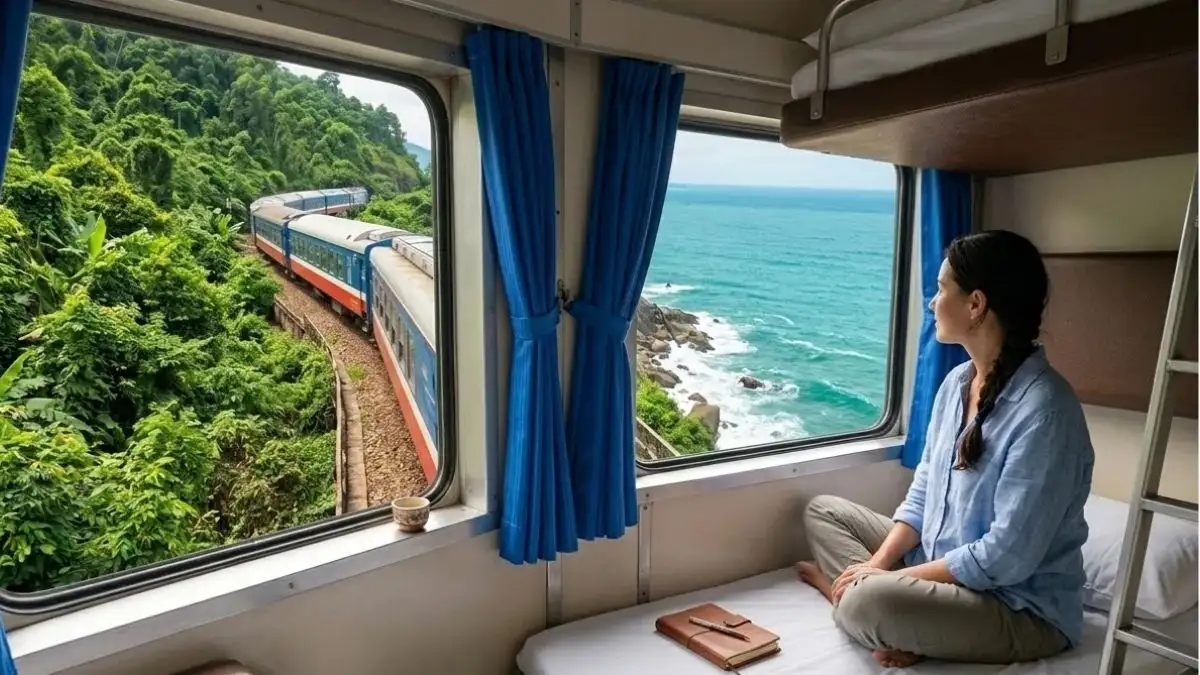
You can also mix transport types instead of choosing one for the whole trip. For example, take an overnight sleeper train for a long north-to-central Vietnam journey, then use a daytime train between Hue and Da Nang to experience the Hai Van Pass. This gives you the practical advantage of a sleeper where the distance justifies it, while keeping the scenic section in daylight.
Read more: Da Nang Railway Station to Hoi An: Complete Travel Guide & Tips
Before you book: A 10-point checklist
A few checks before paying can make the journey much easier:
- Destination: Book your train to Da Nang, since Hoi An has no railway station.
- Arrival: Check the train’s arrival time and allow another 45-60 minutes for the road transfer.
- Cabin: Confirm whether you are booking a 4-berth, 6-berth or VIP cabin.
- Berth: Check your berth position and available luggage space.
- Groups: If travelling together, check whether you can reserve the entire cabin.
- Hotel: Confirm check-in time and ask about early check-in if arriving in the morning.
- Transfer: Arrange your ride from Da Nang station before the train arrives.
- Ticket: Save the e-ticket and QR code offline on your phone.
- Changes: Check the cancellation and ticket-change rules before payment.
- Offline access: Download maps and entertainment before boarding.
For food, you can buy hot meals on many long-distance trains, typically around 40,000-60,000 VND, with snacks costing about 10,000-30,000 VND and drinks around 15,000-35,000 VND. If you need a vegetarian meal, arrange it in advance. Bringing banh mi, fruit or snacks from the station is another simple option.
Allow extra time at the station, especially for an evening departure. Arriving 45-60 minutes before departure gives you time to find the right carriage and platform without rushing. Platform information may appear only shortly before departure, so check the departure board using your train number, such as SE19. Avoid booking a tight activity or onward connection immediately after arrival, particularly if you are travelling overnight.
Arriving at Bliss Hoi An after your sleeper train journey
Da Nang Railway Station is close to the city center, with taxis available outside throughout the day. A taxi to Hoi An usually costs around 350,000-450,000 VND. If you plan to use Grab, install and test the app before your train journey, or check our Grab guide if you have not used it in Vietnam before.
Guests staying at Bliss Hoi An Beach Resort & Wellness can arrange pickup from Da Nang Railway Station through the resort’s transportation service. Ask the resort for the current rate when booking, and share your train number, arrival time and carriage details. The journey from the station to the resort takes roughly 45-60 minutes, depending on traffic.

If you are travelling north again, check your train departure carefully. SE20 currently leaves Da Nang at 17:30, while standard check-out at Bliss Hoi An is at noon. You can ask about early check-in or late check-out, although both depend on availability. With several hours to spare before departure, Bliss Hoi An can also arrange its Basket Boat Tour or Hue City Tour, giving you a way to use the extra time before heading back to the station.

FAQs
Is there a direct sleeper train to Hoi An?
No. Hoi An has no railway station, so every train ends in Da Nang. You then continue by road. Check that your ticket lists Da Nang as the arrival station.
Which train station is closest to Hoi An?
Da Nang Railway Station is the usual choice, about 30 km away. Some services also stop at Tam Ky, which is farther from Hoi An. Da Nang has more trains and more onward transport.
How long does it take to get from Da Nang station to Hoi An?
Most travelers reach Hoi An in 45 to 60 minutes by taxi or Grab. Rush hours, especially 7:30-8:30 AM and 4:30-6:00 PM, can add time. For a resort south of the Old Town, allow a little longer.
Can I take a sleeper train from Hanoi to Hoi An?
Yes, in two steps. Take SE19 from Hanoi to Da Nang, about 16 hours, then continue by car. The whole trip takes about 17 to 18 hours from door to door. If you have a week or less, a flight is usually the better use of your time.

Related Posts

Wood Art Vietnam Workshop: What to Expect From the 3-Hour Wood Carving Class

Where can you get Hoi An ATM Cash and how much can you withdraw?
TEST – n8n WordPress Automation

Hoi An Mid Autumn Festival 2026: 5 Things That Make It Different

Hoi An Old Town Tourist Traps: What to Watch Out For